
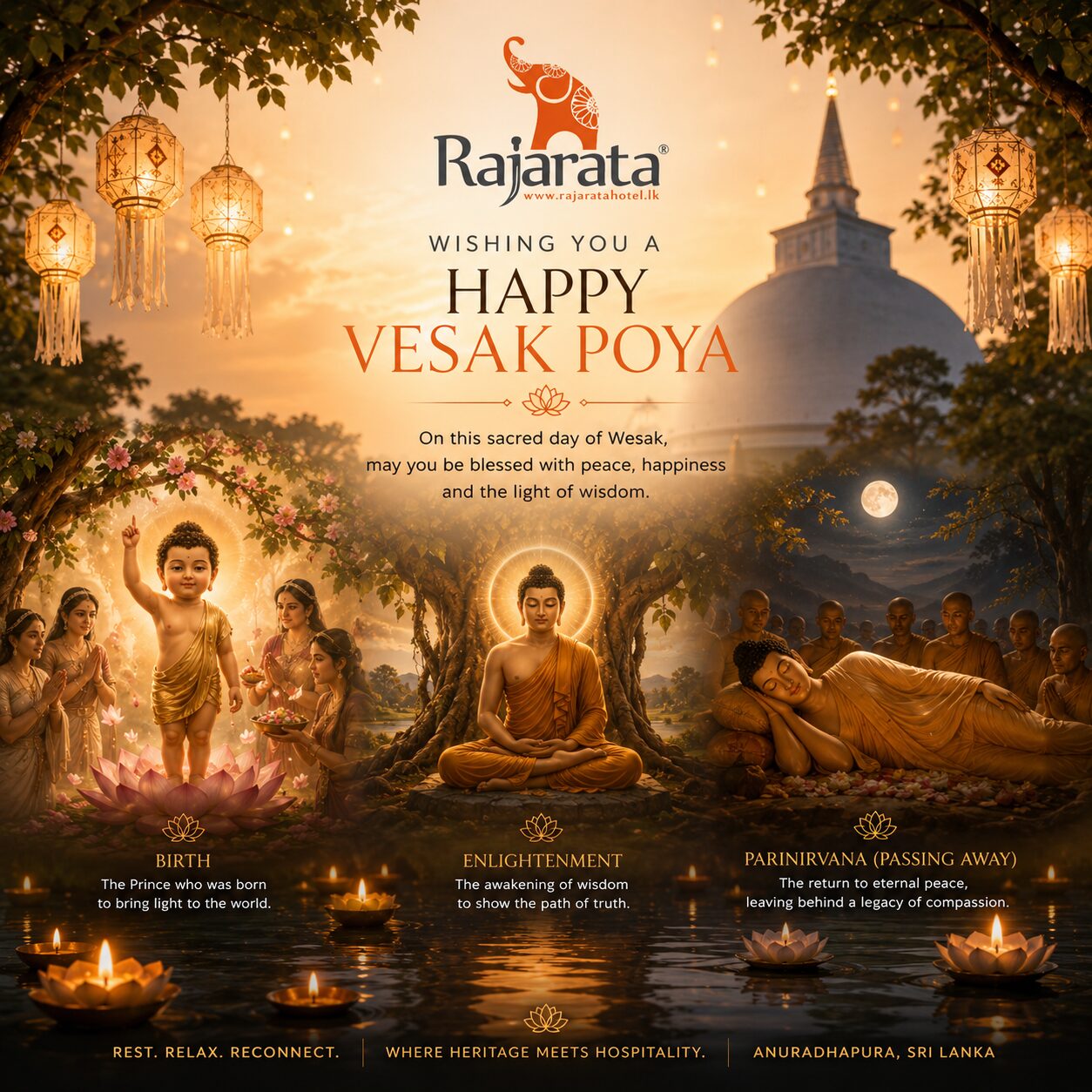
"May the teachings of the Buddha — kindness, mindfulness, and the path of the middle way — bring you peace, wisdom, and the light of understanding."
On this most sacred day, we offer a quiet blessing to all who walk the path, to all who visit the Sacred City, and to all who carry the dhamma in their hearts.
On Wesak full-moon, Buddhists across the world remember three events believed to have occurred on this same night — the birth of Siddhartha Gautama in Lumbini, his enlightenment under the Bodhi tree at Bodh Gaya, and his parinirvana at Kusinara. One day, three turning points of a single life that changed the course of history in South Asia and far beyond.
Nowhere is this day observed with quite the gravity that it holds in Sri Lanka. The Pali Canon — the earliest written record of the Buddha's teachings — was first set down in writing on this island, at Aluvihara in Matale, in the first century BCE. The Sri Maha Bodhi, just a few minutes from where we stand, grew from a sapling of the original tree under which the Buddha attained enlightenment. It is the oldest documented tree in the world, planted in 288 BCE.
For more than two thousand three hundred years, this tree has been watched over without interruption. On Wesak night, the pilgrims arrive in the tens of thousands — white-clad, candle-bearing, walking quietly under a full moon that has shone on every Wesak before. Our home here in Anuradhapura sits within walking distance of that gathering.
If you are here today, in the Sacred City — or you are far away and remembering it — we wish you a quiet, considered, and luminous Wesak. May the next year bring you closer to whatever path you walk.
The Sacred Bo Tree, planted 288 BCE — the most important Buddhist pilgrimage destination in Sri Lanka. Five minutes from the hotel.
Explore the Sacred City →For groups travelling on pilgrimage — Atamasthana visits, vegetarian Kings Platter at Tranquil Restaurant, respectful schedules.
See offers →20% off direct rates on Wesak Poya (30 May) and Poson Poya (27–29 June) — the Sacred City's most luminous nights.
View rates →"Sabbe sattā bhavantu sukhitattā."
May all beings be happy