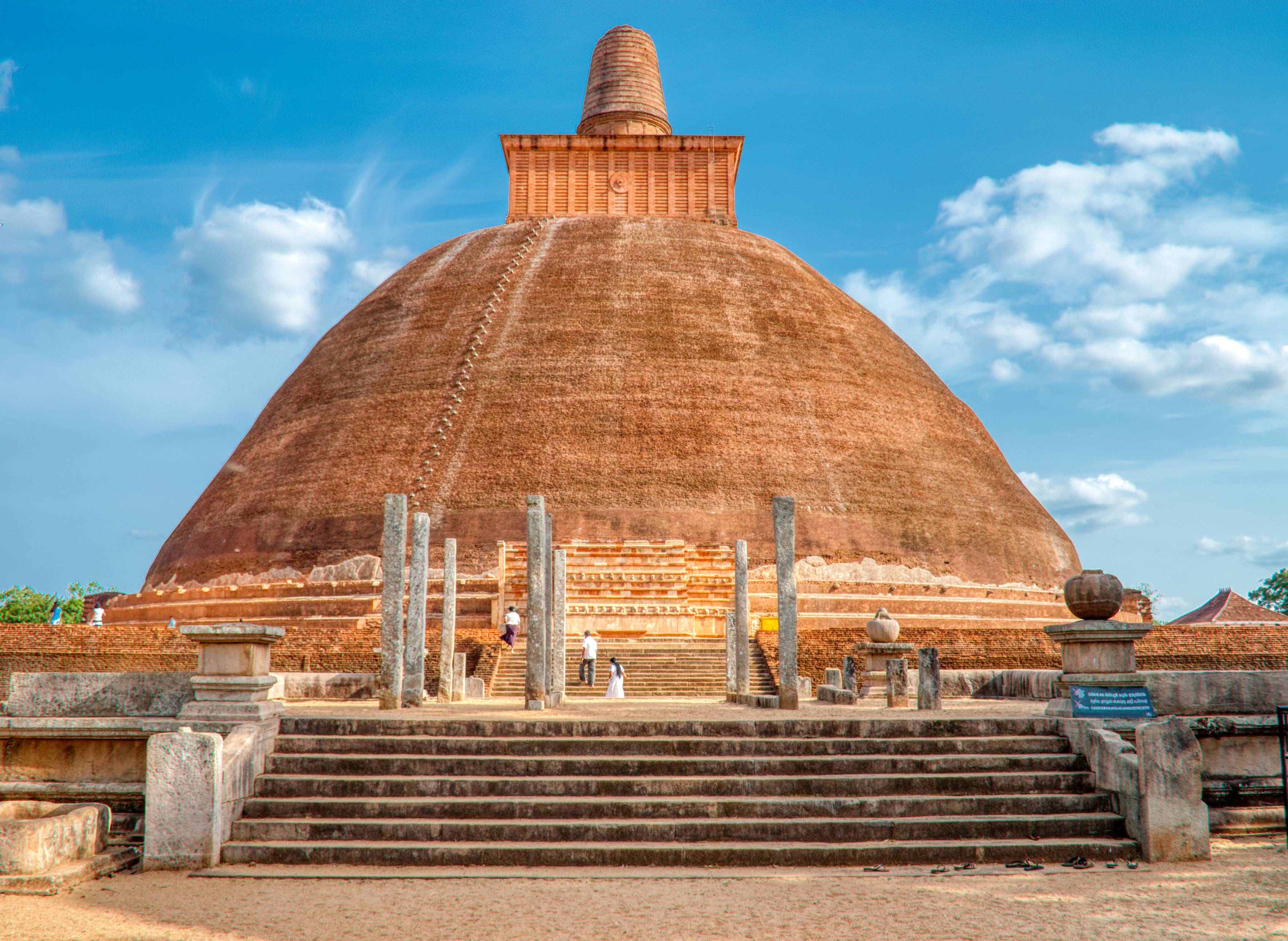
In February of this year, CNN Travel published a long feature on the great brick stupas of Anuradhapura. Its main subject was Jetavanaramaya, the colossal third-century structure that briefly held the title of third tallest building in the ancient world. But the piece kept circling back, as any honest visit to the Sacred City must, to a smaller, whiter, fully alive companion two kilometres to the south — Ruwanwelimahasaya.
If you have come this far down the Northern Line — past the rice fields, past the wewa, past the shaded crossroads with their roadside shrines — you will already have seen Ruwanwelimahasaya. It is, simply, the white dome at the centre of every photograph. It rises above two thousand years of Sinhalese kingship and over a hundred recorded sovereigns. It is, on most calendars and in most hearts, the city's beating organ.
The CNN piece, written by Justin Calderon, made an observation that the dawn light has been making for centuries. The bigger stupa is the more famous engineering story; the smaller one is the city's living one. Jetavanaramaya astonishes; Ruwanwelimahasaya endures.
What was built, and when
Ruwanwelimahasaya — also written Ruwanwelisaya, sometimes the Mahathupa, "the Great Stupa" — was begun under King Dutugemunu in 140 BCE, in the years after his unification of the island. The Mahavamsa chronicle records the day. It records the planning, too: the king's own stone foundation, the brick by brick consecration, the relics chosen for the chamber, the senior monk who presided. The mound was not raised in a single reign. Dutugemunu died with the work unfinished and his brother Saddha Tissa completed the upper structure.
The dimensions are arresting on paper but more so when you stand at the railing. The bell-shape rises beyond one hundred metres from its plinth. The original brick core is faced with white lime plaster, painstakingly re-applied every few years by a chapter of monks who have done little else for centuries. The base is encircled by a wall of 344 carved elephants — figural masonry that remains, twenty-one centuries on, the architectural moment that gives the stupa its scale.
For comparison: when Justin Calderon's CNN feature reports that the much larger Jetavanaramaya was constructed of an estimated 93 million bricks, hauled by elephants and bullock carts, set in a mortar of crushed dolomite, limestone, sieved sand and clay — these are the same techniques, the same labour pool, the same organised state. Ruwanwelimahasaya is the senior. The technologies that allowed Jetavanaramaya to be raised four centuries later were perfected here first.

What you actually see
From a distance the dome reads as a perfect curve. Up close it is a stack of carefully demarcated geometries: the square enclosure, the circular base of three tiered moulded rings, the bell of the dome itself, a square reliquary chamber surmounted by the spire. Each layer is a doctrine made visible — earth, water, fire, air, ether — and the elephants at the base were not decoration but a visible argument about who was carrying the relic.
Walk the inner pradakshina (the circumambulation path) clockwise, slowly. Look for these things in particular:
- The vahalkadas, four small frontispieces at the cardinal points. They are among the earliest examples of stupa frontispiece architecture anywhere in the Buddhist world, and the carving on the eastern face is in remarkably good condition.
- The four standing Buddhas at the cardinal niches, each in a different mudra. The southern one is the original; the others are sympathetic restorations.
- The wall of elephants itself. The figures are almost life-sized, alternately raising and lowering their trunks. Several heads carry recent repairs in lighter stone — a detail any conservator can read at a glance.
- The fragments of the original third-century BCE stone railing, displayed in a small open colonnade by the southern terrace. These are the original elements; the gold-plated railings you see today were added in the modern period.
The relic, and why the stupa is alive
What the visitor's eye misses, the pilgrim's heart finds. Ruwanwelimahasaya is not a monument, in the way a pyramid is a monument. It is a reliquary. It enshrines, by tradition, a measure of the bodily relics of the Buddha — and that single fact is the reason the dome has been continuously plastered, endowed, swept, lit, garlanded and chanted-around for over two thousand one hundred years.
This is the contrast Justin Calderon's CNN piece kept arriving at. Jetavanaramaya was bigger, more architecturally daring, theologically more adventurous. But it lost its monastic chapter, lost its patronage, was truncated by time. Ruwanwelimahasaya never did. It still observes nine daily puja rituals, the first at dawn. On full-moon (poya) days the courtyard fills with thousands of white-clad pilgrims who walk to it from Sri Maha Bodhi a kilometre away. Visitors are welcome to observe — and, if they wish, quietly to participate. It is the unbroken devotional life that has kept this stupa upright while others sank back to the ground.
A post-pandemic resurgence
One of the more quietly moving observations in the CNN piece came not from an architect but from the chief monk of Ruwanwelimahasaya, the Venerable Eetalawetunwawe Gnanathilaka Thero, speaking to the journalist on a poya morning. "First there was civil war, then a pandemic," he is quoted as saying — eight words that compress nearly four decades of silence around the white dome. He went on to note something every concierge in Anuradhapura has noticed in the past two years: the foreign visitor numbers are returning. Quietly, steadily, and, this time, with a different kind of attention.
The hotel's own reservations log tells the same story. In 2019 our guests came mainly for the rooms and the pool, with a half-day at Sigiriya and perhaps a quick early-morning circuit of the Sacred City as an afterthought. In 2026 they are arriving with the stupas already on their itinerary. They are asking for the bicycle hire by name. They are asking, increasingly, for a guide who can read the stones.
How to visit, from the hotel
Ruwanwelimahasaya is 2.4 km from Rajarata Hotel — a five-minute drive, a fifteen-minute bicycle ride, or a forty-minute walk if you are inclined to take the long way past Tisa Wewa. We recommend the bicycle, particularly in cool weather, particularly at six o'clock in the morning.
You will want at least ninety minutes on the platform itself. Allow another hour for the surrounding sites — Lovamahapaya's stone columns are a five-minute stroll east; Sri Maha Bodhi is fifteen minutes south; Thuparamaya is fifteen minutes north. The whole inner cluster of the Sacred City can be walked in a single morning if you start before the heat and finish before lunch.
For visitors who would like to be accompanied by someone who can speak to the inscriptions, the masonry, and the everyday life of the working stupa, the hotel maintains a small panel of licensed archaeological guides. Most are lifelong residents of Anuradhapura. They can be booked through the excursions desk with twenty-four hours' notice, often less.
What the camera couldn't quite show
It is to CNN's credit that they made the journey, took the time, and let the chief monk speak in his own words. Television is good at scale — and Anuradhapura's stupas are scaled for television. But there is a quiet, cumulative quality to the place that does not film well. The way the white dome holds the light at five-thirty in the morning. The smell of cooking oil and frangipani in the courtyard at puja. The shuffling, patient, completely undramatic quality of a thousand pilgrims doing what a thousand pilgrims have done in this exact place since the first century BCE.
The cameras leave. Ruwanwelimahasaya stays. The pilgrims keep arriving. We keep our front desk open. And the white dome, faithfully replastered, faithfully attended, holds its place at the centre of the photograph it has been holding for twenty-one and a half centuries.
Sources & further reading
- Calderon, Justin. "The massive megastructure built for eternity and still standing 1,700 years later." CNN Travel, 4 February 2026. Read the original article on CNN.com — the news hook for this post and source of the chief monk's quoted remark.
- The Mahavamsa (Great Chronicle), trans. Wilhelm Geiger, 1912 — chapters 28–32 cover the construction of the Mahathupa under Dutugemunu.
- Department of Archaeology, Sri Lanka — site documentation and ongoing conservation reports.
- UNESCO World Heritage inscription file no. 200, "Sacred City of Anuradhapura" (1982).